DATALAND, “the world’s first Museum of AI Arts,” paints the industry in a beguiling light (The Architect's Newspaper)
http://archpaper.com/2026/09/dataland-worlds-first-museum-of-ai-arts/
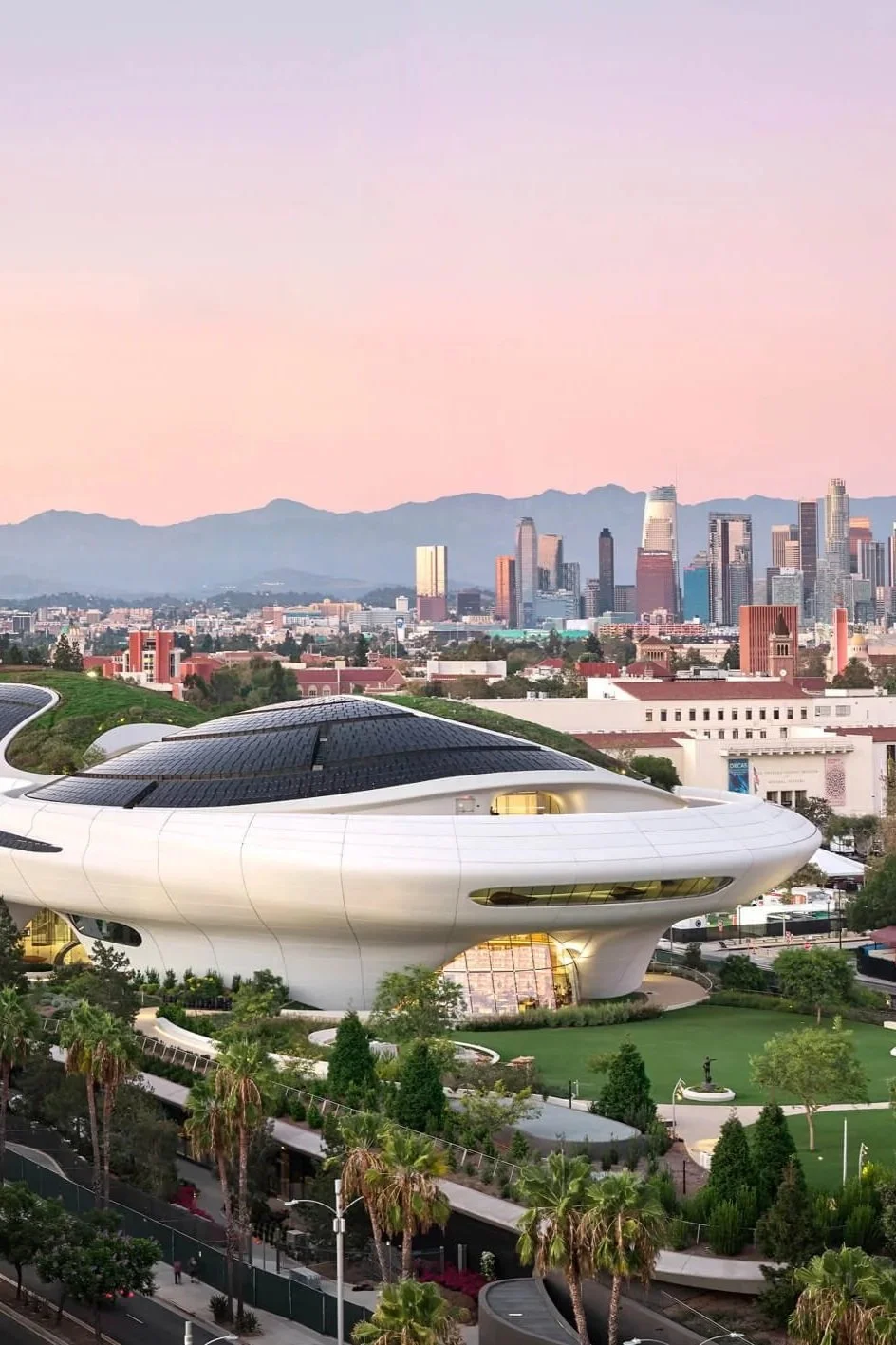
The ground floor of the Grand LA, Frank Gehry’s mixed-use complex across the street from his Walt Disney Concert Hall, remains generally lifeless despite its downtown location. Walking through the courtyard, past a row of empty chairs framed by pristine towers, I joined an orderly line of people waiting to see what DATALAND, “the world’s first Museum of AI Arts,” was all about. What did the titans of big tech, including Google, LG, and Nvidia, buy with their investment? How did Refik Anadol Studio, the Los Angeles–based art and design studio known for dynamic video works covering everything from Sphere in Las Vegas to Antonio Gaudí’s Casa Batlló in Barcelona, employ artificial intelligence across 25,000 square feet of gallery space?
After signing a waiver acknowledging the museum’s collection, use, and storage of “Biosensing Data” to personalize my experience in real time, a group of us filed into the lobby to read a description of DATALAND’s inaugural exhibition on an LED wall while awaiting further instruction. “You are about to step inside Machine Dreams: Rainforest,” it read, “a work of art that is continuously unfolding—a living system powered by the Large Nature Model (LNM), an AI trained on the deepest archive of Earth’s ecological history.”
Baruch Spinoza, a Dutch philosopher In the 17th century, was among the first to think of Nature as a continuously unfolding thing, often attributing capital “N” Nature to the one infinite, all-encompassing substance that is identical to God. “Nothing in Nature is random,” he wrote. “A thing appears random only through the incompleteness of our knowledge.” Does DATALAND depict Nature as something beyond our limited comprehension, or as finally within our grasp, to be laid flat and pumped for information? What is Machine Dreams: Rainforest ultimately exalting: Nature, or Data? Given the visions of the near future expounded by the leaders of the AI industry, you can make an educated guess.
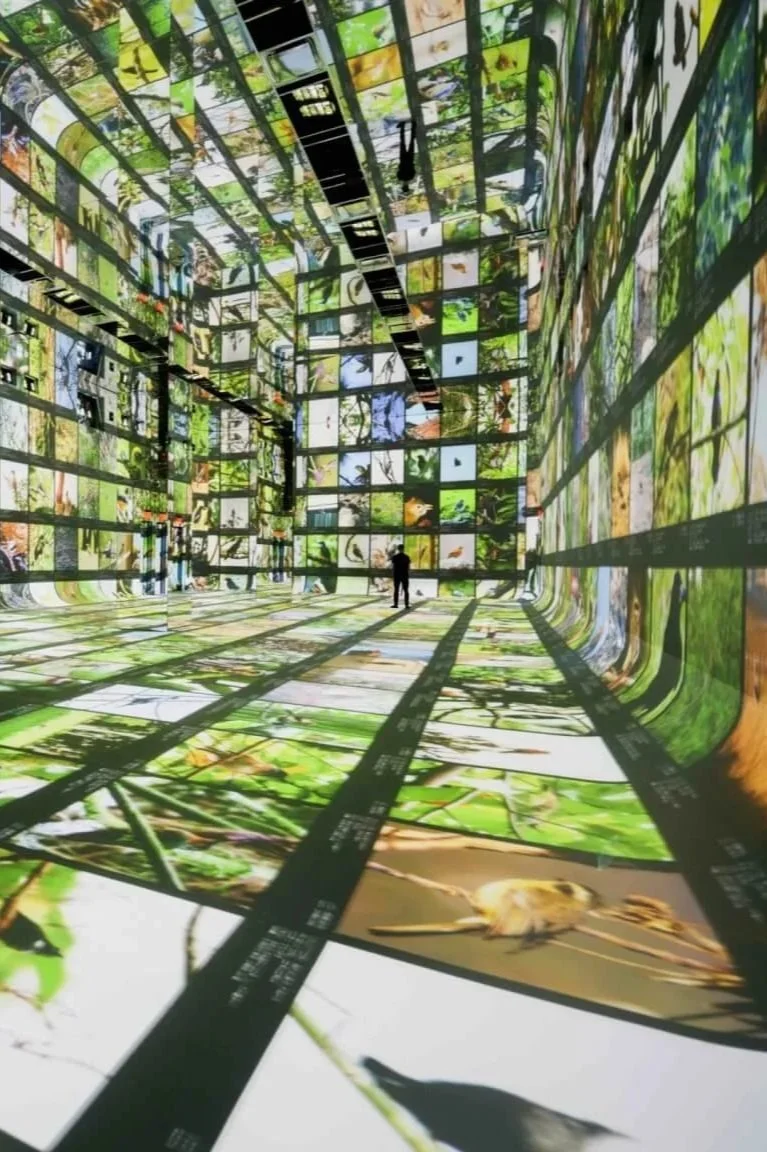
After a second information lobby, in which a scent diffuser was placed around my neck and a sensor slung around my wrist, I was told that what I was about to experience was designed “not to replicate Nature, but to listen to it.” I then descended an escalator into a room without shadows. In the first gallery, titled Data Pavilion, 1.2 billion ecological data points drawn from rainforests around the world are cast onto every visible surface of a cornerless room and divided across 700 million pixels. The imagery cycles between fields of squares, dots, and strands that overwhelm the senses without ever recalling the feeling of walking through a rainforest. The data points slowly move in reaction to the visitor, causing the visitor to slowly move in reaction to the data points. I felt a bit like a clownfish finding my way through a sea anemone, if the sea anemone was a simulation that required a hidden 10,000-square-foot space of heavy hardware infrastructure to operate.
Next, Infinity Room projected an all-surrounding video of “The Dream of Ruwe Pinu,” an artwork developed in partnership with the Yawanawá community of the Acre region of Brazil. It’s based on a dream Refik Anadol had, during a journey into the Amazon rainforest, about “a luminous bird hovering at the edge of a dying forest” that comes to breathe life into a wisdom tree. Is Refik Anadol Studio the bird? Is the promise of artificial intelligence the wisdom tree? Though these questions are left to interpretation, along with any calls to action for protecting the rapidly endangered land that inspired it, the video might play well in Brazil as the nation currently deals with regulatory obstacles to its own adoption of AI infrastructure that include data privacy compliance and developmental gaps between urban and rural regions.
The final gallery space, The Sanctuary, is a thirty-foot-tall video of a whirlpool of flowers, leaves, and other signifiers of serenity. Our movements were tracked throughout the prior galleries on a fine-grain level for the purpose of collectively informing the shape and character of this particular iteration of the video, apparently. Our heartbeats, skin temperature, skin conductivity, and emotional temperature were presented as a raw data stream on the opposite wall in the style of a hospital monitor. “You helped shape this dream,” the video concludes. “Thank you for your presence.” This final message gave me the same warm-and-fuzzies I get every time an electronic toll booth feigns gratitude after I tap my credit card.
While the majority of AI imagery comes in the form of “brain-rot,” which tears our attention spans apart to disconnect us from the world around us, Machine Dreams: Rainforest promises to do the opposite. The exhibition presents artificial intelligence as a medium, quite like Nature itself, that is capable of bridging our individual minds and bodies with our shared environment, but only if we allow it to treat all of the above as reducible to data—only if we allow it to “listen” to us.
But at a time when proponents of artificial intelligence technology are broadcasting its increasing presence in our lives as “inevitable” without leaving room for alternatives, the empathy of an installation that “listens” only on its terms appears as flat as a projection screen. And at a time when the climate is changing so rapidly following nearly three centuries of energy-intensive industrialization, the beautification of this latest energy-intensive industry doesn’t make it any prettier, nor does its promise to eat Nature and digest it as data make it any more trustworthy. Artificial intelligence is capable of many things, but its interpretations of the planet and its life systems are indeed better thought of as “dreams” than as instructions.
The only exit is through the gift shop, where I tapped my bracelet beneath a tablet to reveal my personal “Movement Score” of 479 as it retraced my every step in a floor plan. I was the most still in the Infinity Room, it tells me, and I was most moved by the Data Pavilion. It didn’t mention where I was the most incredulous, but it was in the gift shop, where Nature was decidedly no longer the supposed artistic driver, and I was instead given the opportunity to buy a shirt with my unique data from that day abstracted across the chest.
While writing this article, I listened to Mother Earth’s Plantasia, an electronic album released by Mort Garson in 1976. The tracks—with titles including “Symphony for a Spider Plant” and “Ode to an African Violet”—were composed with a Moog modular synthesizer with the specific aim of stimulating the growth of plants. The science was iffy, but its fealty to Nature remains undeniable.