Museum of the Spectacle (The Architect's Newspaper)
https://www.archpaper.com/2026/09/lucas-museum-narrative-art-opening/
While many of us have wondered what distinguishes “narrative art” from regular old art, George Lucas has known perfectly well all along. With an $11 million budget, Lucas wrote and directed Star Wars: Episode IV – A New Hope, which, against all expectations, grossed $410 million worldwide during its initial run in 1977. To worldwide audiences, it didn’t matter that the space opera was an analogy for the Viet Cong’s valiant defense against the United States military, nor did it matter much to its creator that they didn’t see the connection. Narrative art, for Lucas, is principally concerned with captivating an audience through storytelling and spectacle. Anything it does on top of that is just gravy.
After selling his production company, Lucasfilm, to The Walt Disney Company in 2012 for $4.05 billion, Lucas spent about a third of his earnings on a museum devoted to the kind of art often overlooked by the cultural sphere: science fiction illustrations, comic strips, paintings of dogs playing poker. After unsuccessful bids in Chicago and San Francisco, the Lucas Museum of Narrative Art eventually terraformed a 13-acre parking lot in Exposition Park, a 160-acre cultural campus in South Los Angeles.
MAD Architects, a Beijing-based firm, has been along for the entire ride, offering audacious designs suited to all three locations. MAD is unapologetically in the business of spectacle, having completed mountainous landform complexes and towers resembling Marilyn Monroe. “Architecture is automatically a form of narrative art,” Ma Yansong, MAD Architects’s founder, tells me over lunch. “It helps provide a narrative for life.”
What narrative, then, does the Lucas Museum tell?
During his press opening remarks on September 2, Lucas was apparently overcome with a familiar feeling. “I’m used to doing the impossible,” he said, “but this one almost broke my will.” Perhaps he was thinking back to the eight-year-long construction process or the high-profile museum leaders that quit en masse earlier this year due to a major internal reorganization. It was true in the Gilded Age, and it’s true now: Throwing money at a museum doesn’t make the institutional obstacles disappear.
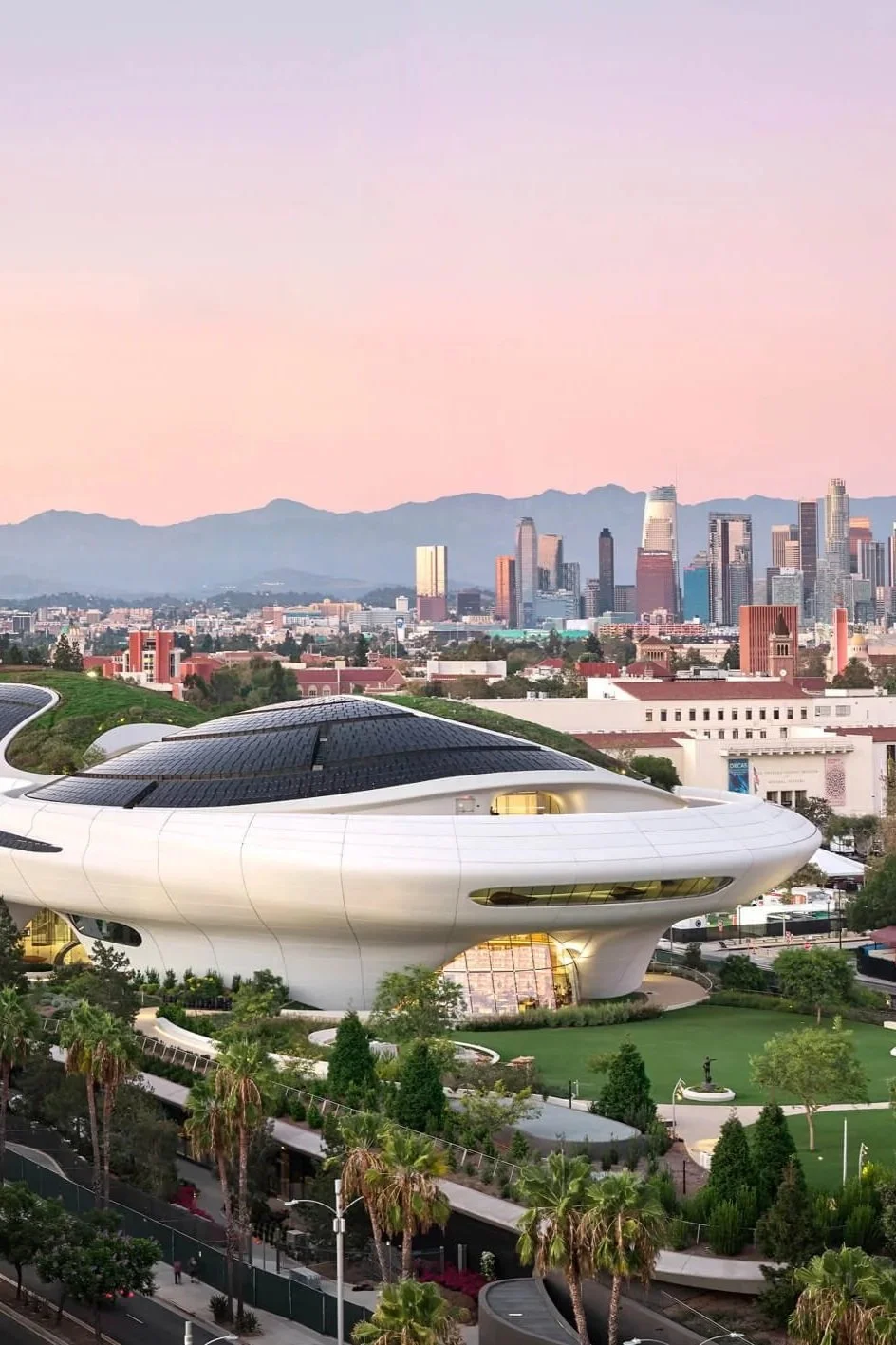
From nearly every vantage point, the building can be likened to things that only exist in science fiction: a spaceship, a mars colony, a landscape of the ancient future. The more than 1,200 uniquely curved fiberglass-reinformed polymer panels are installed with tight enough tolerances as to read like a continuous shell. (As presented at Facades+ Los Angeles in 2023, the panels were fabricated by Kreysler & Associates with Walter P Moore serving as the facade consultant with Stantec as the architect of record.) The swooping form sports a green rooftop and rises within an 11-acre park designed by local landscape architecture firm Studio-MLA, ensconcing the museum in indigenous and drought-tolerant plantings within a similarly contoured topography.
Its vibrant green lawn and hanging gardens, privately maintained by the museum, will stand in ever greater contrast to the browning grass of the public park just beyond its perimeter. And while the parking garage is covertly tucked beneath the grounds, making the entry sequence smooth as silk for anyone driving to the museum, those arriving from the Metro are greeted by an extended sequence of blank walls before happening upon either of two enclosed ticket booth pavilions. The building is spectacular in its uneasy relationship with the world to which it suddenly belongs. No longer merely an image, the Lucas Museum is a priceless artifact set in the middle of South Los Angeles.
Beneath a 185-foot building span with an oculus at its center, the Lucas Plaza comes into view past the turnstile, at an angle like an establishing shot of a pivotal scene. On one side is the research library, generously open to the public without a ticket. Past the double-height lobby, with an N-1 Starfighter suspended from the ceiling, is a wood-lined cornucopia of books on art and symbols, largely donated by the actor Steve Martin and otherwise from the personal library of the late writer Joseph Campbell, Lucas’s former mentor. Anyone losing focus from their studies may look out toward the sculpture garden to lock eyes with Princess Leia as she chokes out Jabba the Hut.
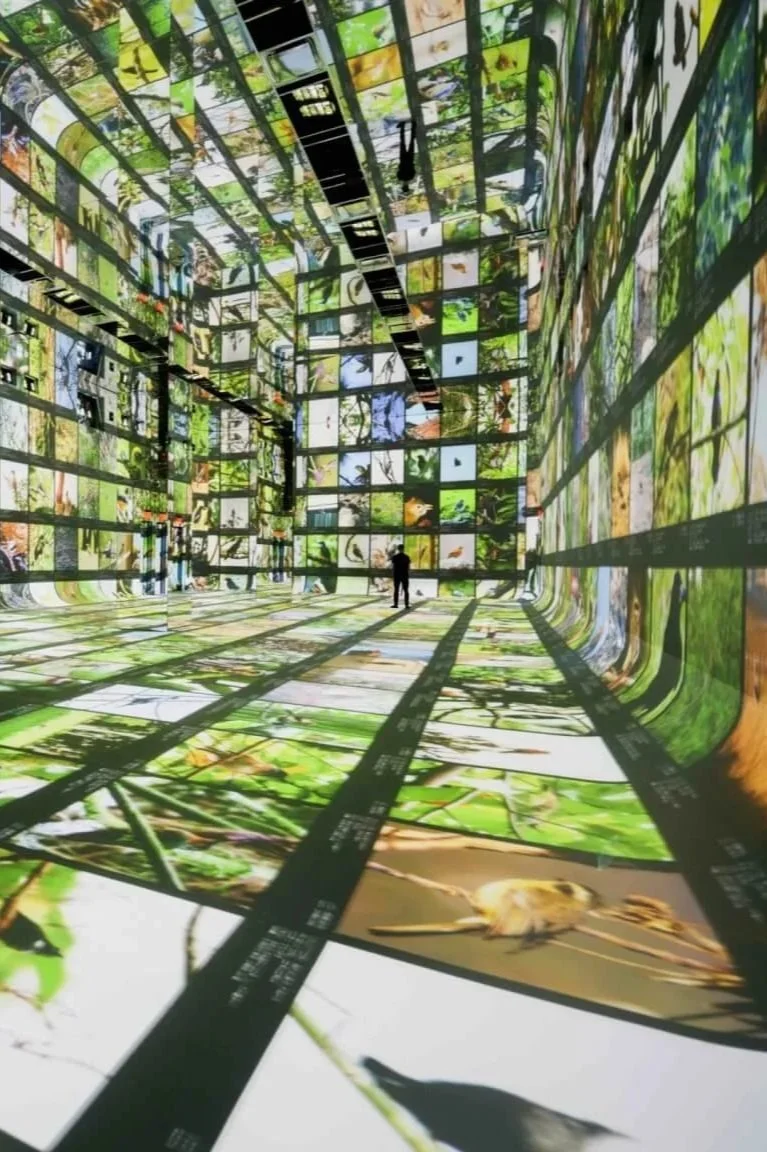
The attractions on the cavernous ground floor of the opposite side are a similarly hearty mix of entertainment and education. Some are hypnotic, like the two theaters—one devoted to documentaries about the creative process of narrative artists like J. C. Leyendecker and Charles M. Schultz, the other to original animations and short films—that play their features on a continuous loop from open to close. Others are baffling, like “The History of Narrative Art,” a gallery of the world’s most significant works of art reproduced as backlit images and 3-D scans thrown into a fast and loose historical sequence. The Cave of Altamira, dramatically scaled up to reveal the illustrative details of ancient cows and bulls, leads to the Sistine Chapel, dramatically scaled down to make room for the Aztec Sun Stone and a panorama of the Hagia Sofia.
A bank of space-age glass elevators in the lobby whisk viewers up to the main gallery space on the fourth floor—“a metaphor for parting with reality,” Yansong told me. I am not the only one to compare it to Peter Zumthor’s David Geffen Galleries at LACMA, if only because they are the two starchitect-designed, organically shaped, single-floor art galleries completed this year that each hover around 100,000 square feet above the Los Angeles basin.
Yet the two differ entirely when it comes to their philosophies toward context. While Zumthor throws artworks into a roiling ocean of global exchanges and textured concrete against unceasing views of the city, implying that art is best understood as relational, MAD organizes them within womb-like spaces that cautiously flow into one another.
The galleries are set within a grid of narrow streets and wide boulevards, which are themselves blank aside from the occasional KAWS sculpture or manga illustration peeking out. The ceiling is nothing to look at—a utilitarian matrix of track lighting suspended from concrete-sprayed steel—while the flooring is a forgettable checkerboard wood pattern. The focus is on the narrative art. Whenever it builds into a loud chatter, visitors can take a break in any of the three “viewpoints,” white-walled cocoons with framed vistas from which to marvel at the outside world from a distance.
The galleries are categorized with emotionally charged themes like “Love” and “Play” and “Western Stories.” Surprisingly or not, the “Cinema” gallery is exclusively Star Wars memorabilia, while the “Architecture” gallery is exclusively large-scale photographs of MAD’s completed work, a model of the museum, and renderings of earlier design iterations.
There is, thankfully, relational curation where it counts: Norman Rockwell’s The Runaway, an innocuous painting from 1958 depicting a young, nervous boy sitting inside a diner next to a police officer, is placed along Anthony Freda’s 2014 reworking. Following the fatal police shooting of Michael Brown, an unarmed 18-year-old Black man in Ferguson, Missouri, Freda recast the boy and militarized the officer’s uniform, reminding us that the power of narrative art can sometimes shift over time.
A smaller gallery on the fifth floor is dominated by large-scale works by Diego Rivera, Judy Baca, JR, and Banksy. These artists have dismissed the high-brow imperatives of subtlety and nuance to cast a harsh light on reality for those conditioned to follow grand narratives wherever they lead. Though it’s an unexpected departure from fantasy, its consistent dedication to spectacle makes it work with the museum’s overall message.
But if politics aren’t your thing, you can take the elevator back to the theater lickety-split and watch cartoons until the museum closes.